
Chart Prattville Previous Residents
A house history begins by matching the question to the right era. Current appraisal and mapping identify the parcel now. Autauga Probate carries the ownership chain into the nineteenth century, while named occupants appear more directly in directory and census sources. Fire-insurance maps show the building and its setting. City permits can date later work, though no browseable local permit-history portal was verified.
| Historical source | Verified years | Where held | Evidence for an address |
|---|---|---|---|
| Recorded books and microfilm | 1820 to October 31, 1996 | Autauga Probate Records Room | Grantors, grantees, plats, liens, and title terms |
| Office computer index and images | November 1, 1996 to present | Autauga Probate Records Room | Newer transfer chain and recorded images |
| Prattville directories | Scattered 1962 to 2001 | Alabama Department of Archives and History | Named entries, address, and occupation when printed |
| Federal census schedules | Decennial schedules through 1950 | NARA and research access points | Household members and relationships on census day |
| Sanborn map sheets | 1894 and January 1911 | Library of Congress | Street labels, building footprint, use, and materials |
| Current appraisal and GIS | Current roll and map | Autauga County online systems | Starting owner, parcel, situs, legal description, and county |
| City permit records | Contemporary form verified; start date unknown | Prattville Planning and Building | Project address, parties, proposed work, and dates |
Start with appraisal and deeds for a title question. Start with a dated directory or open census for a household question, then use the deed chain to keep the address tied to the same land. For an older structure, add Sanborn evidence before assigning a resident to a building that may not yet have existed.
Fix Prattville Resident Parcels
Prattville reaches into Elmore County even though it is the Autauga County seat. A Prattville mailing label does not select the custodian. Confirm the parcel's county before requesting a deed, estate, tax card, or permit record. For an Autauga parcel, search the Citizen Access Property Search by exact address and save the owner spelling, parcel and key numbers, situs, mailing address, and legal description.
The legal description is the durable thread. A subdivision lot and block or a metes-and-bounds description can survive a changed street name, a new house number, or a postal adjustment. Situs means the assessed physical location. Mailing address means the destination for tax correspondence. Neither alone proves who lived there. Historic properties near Autauga Creek may be described by acreage, roads, mills, or neighboring lands rather than a familiar modern number.
Once the land is fixed, compare the map polygon with the appraisal record and any cited plat. If the parcel is in the Elmore portion of Prattville, switch to Elmore County's property and probate offices. That county check is the most important geographic safeguard in a search for past occupants.
Note: No authoritative Prattville street-renumbering project was found, so prove any address change from dated records instead of assuming a citywide event.
Trace Past Prattville Residents
The current parcel points to the first deed, but the full chain must be built at the Autauga Probate Recording Department. The office indexes recorded parties rather than all street addresses. Search the present owner as grantee, locate the acquisition instrument, and compare its legal description with the parcel. The deed names the grantor, who becomes the next person searched as an earlier grantee.
- Save the present owner, parcel, key, and complete legal description from appraisal and mapping.
- At the Records Room, find the current owner's acquisition deed and verify the land, document type, and recording date.
- Record the seller or grantor, then search that party as a grantee during an earlier span.
- Repeat the transfer sequence, checking referenced plats and recitals when the property description changes form.
- When a trust, estate, or company enters the chain, use probate or business records to explain the transfer before moving back.
- Grantor
- The party transferring an interest in the recorded instrument.
- Grantee
- The party receiving the interest and the role used to locate that party's purchase.
- Chain of title
- The linked sequence of recorded transfers affecting the same land.
- Legal description
- The recorded land description that is more stable than a street address.
A chain of title identifies owners, not all former occupants. An owner could live elsewhere, and a household could occupy the property without appearing in the deed. Keep title evidence in one column of the research notes and occupant evidence in another.
Cross Prattville Record Room Eras
Autauga Probate publishes a precise access divide. The office computer carries index entries and images from November 1, 1996 forward. Earlier material from 1820 through October 31, 1996 is held in microfilm or bound volumes. Searches in both eras must be performed in person. Staff assist with equipment but will not provide deed book and page references over the telephone.
The Autauga Probate contact page is a useful source before a research visit. Its captured view helps locate the recording and archives contacts:
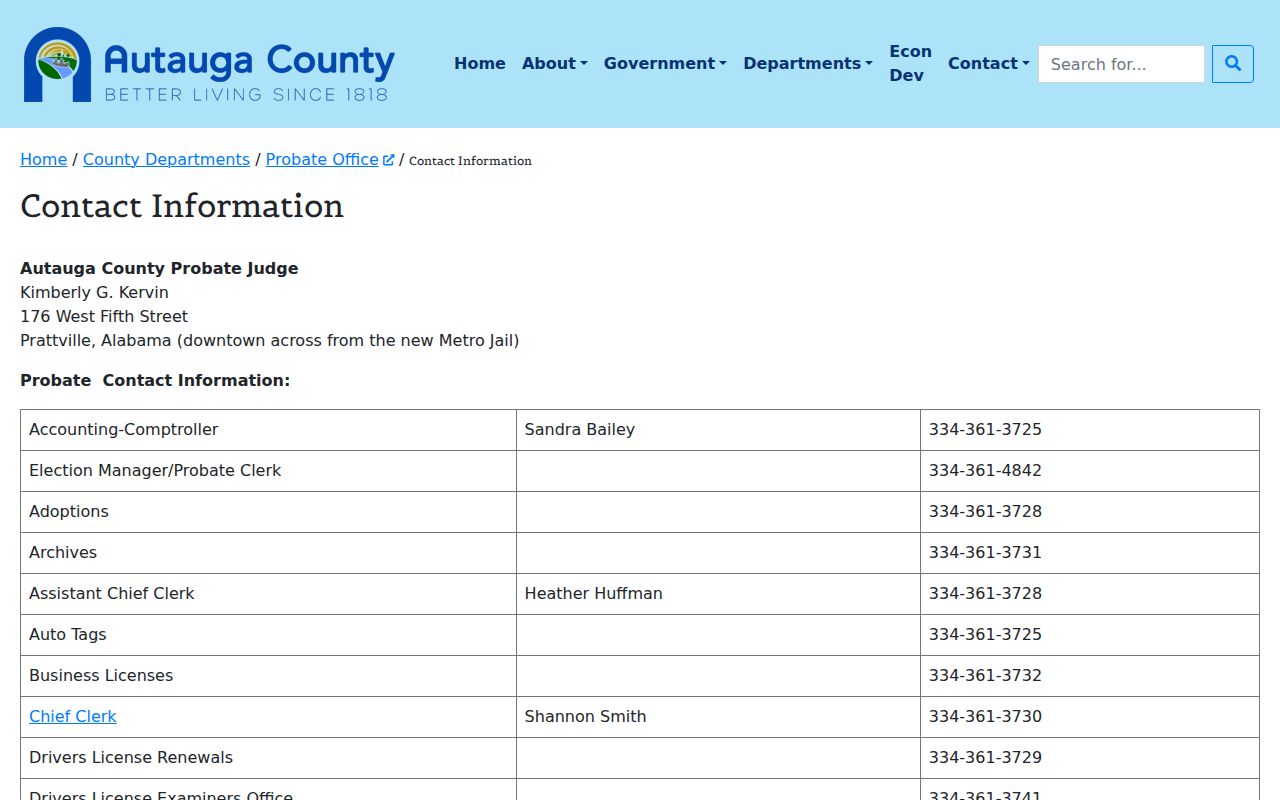
Call to confirm current hours and equipment access, not to ask staff to perform the deed chain. Bring a worksheet of name variants, date ranges, and legal descriptions. That preparation makes the 1996 transition a change of format rather than a break in the research.
The county's recording fee schedule concerns filing deeds, mortgages, plats, and related instruments. The successful capture shows the published schedule:
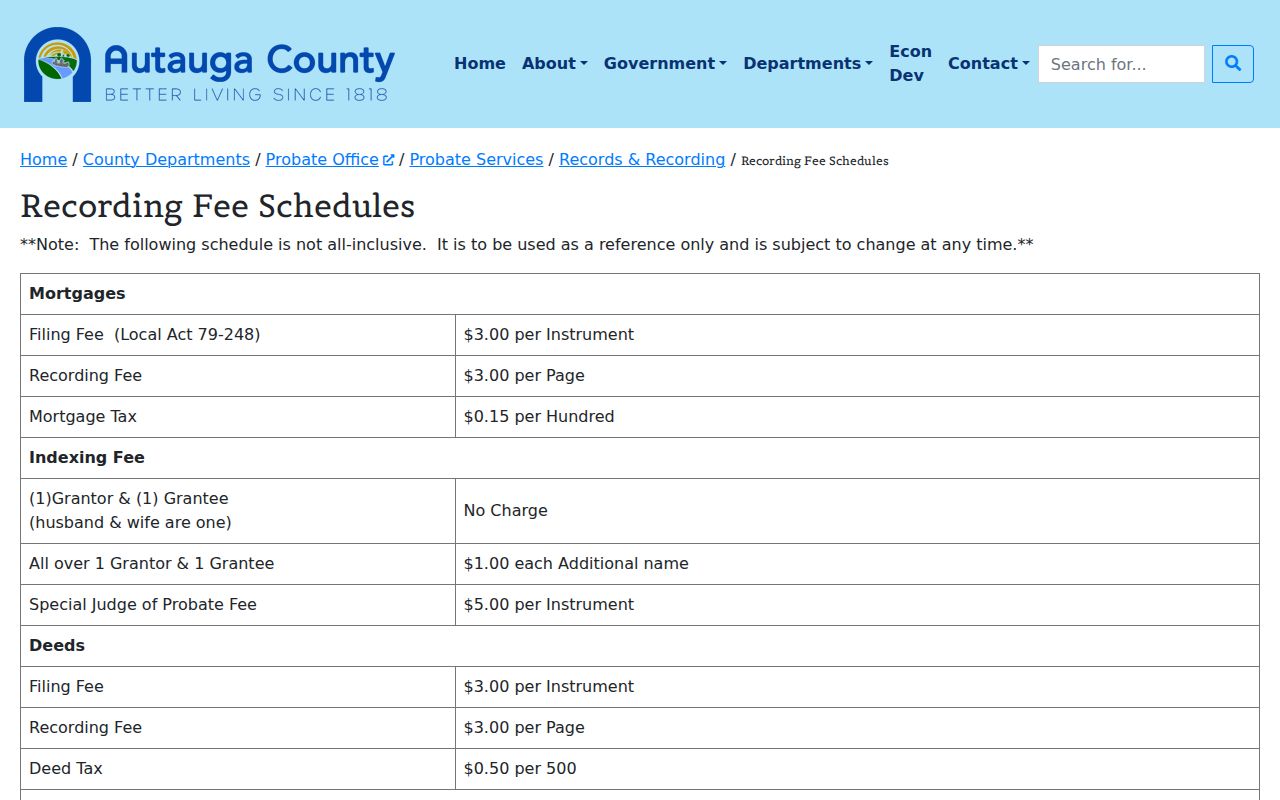
Ask the office for current copy and certification costs before ordering. Fees on the schedule can change, and the instrument filing formula does not establish what a historical image copy will cost.
Records Room tip. Carry every spelling variant and search both party roles; the office computer is onsite, not a remote public deed portal.
Match Prattville Directory Gaps
The strongest verified named-occupant source is the Alabama Department of Archives and History city-directory series. Prattville is not represented every year. The confirmed volumes are 1962, 1964, 1967, 1969, 1971, 1972, 1974 through 1976, 1979, 1980, 1982, 1984, 1985 through 1987, 1990, 1992, 1995, 1999, and 2001. Several years have duplicate copies, but duplicates do not fill missing years.
Use the volumes as checkpoints. An alphabetical entry may print a name, spouse, work, and home address, subject to that edition's own key. A reverse street section could place house numbers in order, but such a section has not been verified in every Prattville book. Inspect the table of contents and abbreviation page onsite before calling any volume a criss-cross directory. The detailed collection belongs on the Prattville Directory Book page; here, it serves the backward address trail.
- Choose the directory year closest to the known deed, family event, or move date.
- Copy the entry exactly, including initials, spouse notation, occupation, address, and printed abbreviations.
- Search the next available Prattville volume, not an assumed next year, and note each gap.
- Pair entries near 1950 with the released federal census while respecting the census date and address wording.
- Use newspapers, probate, and deeds to test changes that fall between directory or census years.
The 1950 census is the latest publicly released federal population schedule. The 1960 census remains closed until 2032 under the 72-year rule. Therefore, most of the verified Prattville directory run cannot yet be paired with a same-decade public household schedule. State that gap instead of implying that every directory resident can be expanded into a census household.
Map Early Prattville Resident Homes
The Library of Congress provides free Sanborn evidence for Prattville before the verified directory shelf. A January 1911 Prattville map has three sheets. Prattville sheets also appear within an 1894 Montgomery volume, so a search limited to titles beginning with Prattville can miss them. The maps record street labels, structures, industrial context, use, and fire-related building facts.
Sanborn maps do not name each occupant. Use them to ask whether a building existed, how its footprint changed, and what the street was called. Then connect that place with deeds, probate, newspapers, and later directory entries. In Prattville's mill-centered historic core, industrial landmarks and Autauga Creek may make the mapped site easier to recognize than an early deed's street wording.
Compare both map dates with the same land description and nearby fixed features. A changed footprint can narrow the date of construction or an addition, but it cannot identify a household without a second named source.
Note: The 1894 catalog placement under Montgomery is a real retrieval quirk, not evidence that the Prattville sheets cover Montgomery property.
Date Prattville Resident Address Changes
Prattville's October 2024 commercial permit application records a project address, owner and applicant contacts, project type, contractors, plan materials, and Historic District or floodplain flags. Separate trade permits may exist. The form says work must begin within six months and finish within one year unless Planning renews the permit. A filing therefore dates an application and planned work, not necessarily final completion or residence.
No public address-searchable permit history or coverage start was found. Request a known property and time range from Prattville Planning and Building rather than claiming a complete online archive. A permit can help explain a new structure, addition, demolition, or change in use. It does not show every person who lived there.
Preserve all address variants found in dated sources. Search old road wording, modern situs, parcel number, and legal description. If the street number shifts between a map, directory, deed, and permit, align the parcel and building facts first. No verified Prattville renumbering ordinance can be used as a shortcut.
Close Prattville Resident Trails
When a name disappears from a directory, do not assume a move. Check spelling variants, initials, married or maiden names, and nearby available years. A death record, obituary, cemetery source, or probate estate may explain the end of a household's address trail. Alabama statewide death registration begins in 1908, while recent death certificates remain restricted for 25 years. Older or eligible records follow the Department of Public Health rules.
Autauga Probate estates can identify a decedent, personal representative, heirs or devisees, counsel, property, and notice addresses when those parts of the file are public. Funeral notices and newspapers may connect relatives, churches, and cemeteries, but family-submitted claims need confirmation. The ADAH Autauga subject files add “People,” “Historic Homes,” “Churches and Cemeteries,” schools, industries, and several Prattville folders.
The Autauga County Heritage Association and The Pratt can route a focused question about a surname, property, cemetery, photograph, or local file. Its assigned image shows the local history research gateway:
Ask about research policy and fees before sending a broad request. A narrow query with an address, surname, and date span is more useful than a request for every past resident.
Prattville Previous Residents Limits
Past occupants and previous owners are not the same group. Deeds follow title. Directories can omit unlisted people, and the verified Prattville volumes have long gaps. Census schedules capture one date and stop at the public release line. Sanborn maps describe buildings rather than households. Permits document work. Each source contributes one type of proof.
The missing sources also matter. No official public Autauga grantor-grantee web screen was found. No itemized Autauga-Prattville Public Library house-history guide, digitized local criss-cross run, or obituary index was verified. No authoritative courthouse disaster or lost-record event was located. Preserve these as research limits instead of filling them with generic claims.
Lawful use. Research Prattville past residents for house history, genealogy, estates, and personal curiosity. Never use a past address trail to harass or track a living person.
A careful answer may remain a date range. Record which source proved ownership, which named an occupant, and which only described the building. That distinction is the best defense against attaching the wrong household to a Prattville address.